Showing posts with label Kenya. Show all posts

Thursday, 6 September 2018

KENYAN INNOVATION TAKES PLASTIC BAGS OUT OF FORESTRY


Hello All,

please find here below an article I recently found in a BBC link which was talking about plastic pollution and reforestation.
Kenya already banned the use of plastic bags in 2017, what are we waiting for?

Great highlights and new points of view form Kenya, enjoy the reading!!


"KENYAN INNOVATION TAKES PLASTIC BAGS OUT OF FORESTRY

Plastic bags are known for their environmental impact. They slowly release toxic chemicals once in the soil, for instance, and find their way into the guts of animals that often choke and die as a result.

Kenya banned the use of plastic bags in 2017. And thanks to a 43-year old Kenyan, Teddy Kinyanjui, an innovative afforestation and reforestation method for developing seedlings without using plastic bags is in place.


A resident of Nairobi and founder of Cookswell Jikos Limited, Kinyanjui has invented small, portable seed balls to grow and easily disperse seedlings. He is working in partnership with Kenya Forestry Research Institute (KEFRI), which certifies seeds.This photo gallery shows Kinyanjui’s ingenuity in using the seed balls instead of the usual plastic bags.

When tree seedlings are grown in plastic bags in a nursery, he explains, the roots get squeezed and this limits their ability to grow fast. The seed ball method enables roots to adapt easily, with less disturbance.
Kinyanjui says he has engineered a method of coating each seed with charcoal dust, and corn or cassava starch, to bind each ball so the seeds are protected from prey, pests and diseases.


He says he has the capacity to make one tonne of the seed balls per day. So far, since the project’s initiation in 2016, about one million seeds of different species of certified indigenous trees have been dispersed throughout Kenya through partnerships with locals and with a germination rate of 60 per cent.
“People use charcoal every day, necessitating for more trees. Climate change has also caused community conflicts, especially among pastoralists in Northern Kenya who fight over pasture for their animals,” says Kinyajui. “Good environmental management is, therefore, crucial for peace among these communities.”

He hopes to partner with like-minded organisations and youth who herd livestock with slings to disperse more seeds in arid lands.

“We would [also] like people to see the value of this simple technology
 as a contributing factor in combating and adapting to effects of climate change, as this is the cheapest way to encourage tree planting, especially in arid and semi-arid areas,” adds Kinyanjui."


Full article can be found:
https://www.scidev.net/global/environment/multimedia/kenyan-innovation-takes-plastic-bags-out-of-forestry.html

Monday, 23 April 2018

G ADVENTURES - PLANETERRA


Today I would like to talk about travellers and travelling.

Most of the time, travelling is associate to a possible threat to natural environments and local communities of a country rather than something beneficial.


G Adventures seems to make the difference.
This travel company for over 25 years not only helped travellers to integrate travelling into the different cultures but it also sustained local communities while doing that. After the firsts successes in 2003, Mr Bruce Poon Tip founder of G Adventures, established a non-profit organization called "Planeterra Foundation". The aim of this company is to invest the donations they collect from travellers into development projects, in the last 15 years they have been able to support different businesses from healthcare to conservation. 
This is how they define themselves: “Planeterra helps to start something. Once a social enterprise is up and running the impacts begin to multiply within the community. We believe that tourism can be the greatest method of wealth distribution in the world, and we’re out to prove it.”  <https://planeterra.org/about-us/>


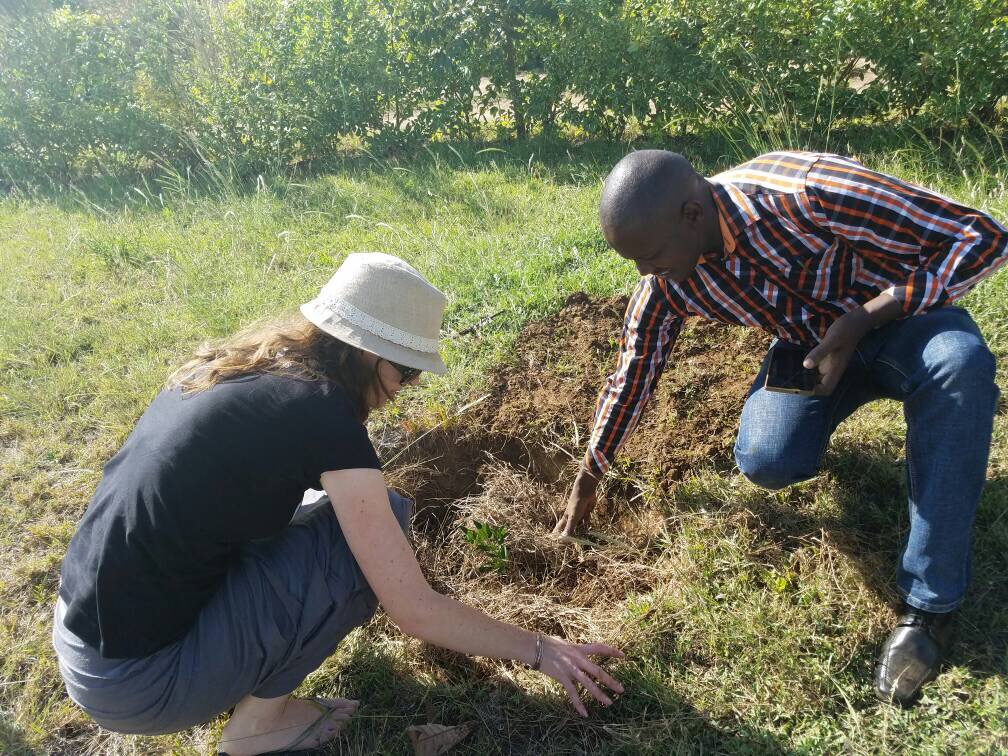
In Nairobi in Kenya, for instance, G Adventures Safari Central cooperated with Café’ Ubuntu. Together they planted trees during the Earth Weeks and now this café’ supports Special needs' schools and local women whose children are living with disabilities.


Among the various projects Planeterra is developing there is also one in Guneysinir, in Turkey. This area is particularly dry and between July and September, and the average rainfall is less than 10mm. Accordingly with recent researches on the territory, it resulted that the population is growing and the limited agriculture resources of the natural environment are unable to feed the population.

Considering characteristics of this land, it has been found out that almond orchards are the best trees to plants in order to optimize the water retention. When travelling with G Adventures in Guneysinir, there will be the chance to plant some trees in the orchard. Tourists will have the opportunity to visit the park, interact with the local residents and learn further about the project. This almond plantation provides sheds for people, improves water  retention in the soil and the selling of almonds is a source of income.

 “This project was inspired by conversations with G Advenutres' field staff and the residents participating in the home stay experience. The goal is to provide an opportunity for travellers to spend time in a community park and contribute to a budding social enterprise. With the help of the local municipality, we identified a 10,000 sq.m. plot of land that is perfectly suited for this type of multi-year development project.” <https://planeterra.org/what-we-do/our-projects/turkey-almond-cooperative/>

 
I got to know G Adventures during my University time when I attended a convention held by mr Poon Tip here in London. I found very inspiring this new way of looking at tourism as a resource rather than as something harmful.
I firmly believe there should be more initiatives like this, the world is one and it is an unique place: we need to take good care of it.

Monday, 13 February 2017

WANGARI MAATHAI & THE GREEN BELT MOVEMENT (GBM)

WANGARI MUTA MAATHAI

Wangari Muta Maathai (01.04.1940 – 25.09.2011) was Kenyan internationally known for being an environmental political activist and Nobel prize. She studied in the University of Pittsburgh in USA and at the University of Nairobi in Kenya.

In 1977, Maathai founded an environmental non-governmental organization which concentrated on tress planting,environmental conservation and on the rights of the women: it is called the Green Belt Movement.
In 2004 she was awarded with the Nobel Peace Prize for "her contribution to sustainable development, democracy and peace", becoming the first African woman to receive such a rewardThis recognition lead Maathai to be elected as a member of the Parliament as assistant minister for Environment and Natural Resouces untill November 2005.
In 2011 Maathai died.


THE GREEN BELT MOVEMENT

The Green Belt Movement (GBM) was founded by Professor Wangari Maathai in 1977 in order to recover a situation of decadency that was affecting the women of the rural areas of the Kenya. Women were encouraged to work together and their were taught how to grow seeds, plant trees on soil, store rainwater and provide food and firewood and get money from it, in order to overcome the lack of food supply and poverty.


This institution educated the population about protecting the environment, the issues of the deforestation and climate change.

Currently, communities come together to plant trees and as consequence the reforestation is taking place.


The GBM operates in four areas such as: Trees Planting and Water Harvesting,Climate Change, Mainstream Advocacy, Gender Livelihood and Advocacy. 


Trees Planting and Water Harvesting: the aim of this operation is to preserve the biodiversity of the natural environment and re-balance the ecosystem.
Climate Change: the objective is to educate the local communities about the important role that the conservation of the natural environment plays to contrast the climate change.

Mainstream Advocacy: it is meant to contrast the corruption in Kenya but mainly the deforestation which is taking place without any control.
Gender Livelihood and Advocacy: the reforestation of some area already empowered 
local communities to grown their own food and shed their families.

Nowadays, the Wangari Maathai and the Green Belt Movement legacy continue and anyone interested can get involved through work opportunities, internships or volunteering.
Jobs in these areas are aimed to support the local communities and guests are invited to take part in Safaris and experience culture and heritage of the residents.

I believe this is a great opportunity 
to explore a new culture and lifestyle first hand, especially for students or anyone interested to have a gap from their routine.
Please let me know your thoughts and your experiences if you decide to move over there.

For further and complete information please visit the below websites:
http://www.greenbeltmovement.org/wangari-maathai/biography
https://en.wikipedia.org/wiki/Wangari_Maathai