The driving idea behind this blog is to raise awareness among people about the importance to be surrounded by trees and green areas.
My aim is to post useful information about this topic and help local association to spread the word.
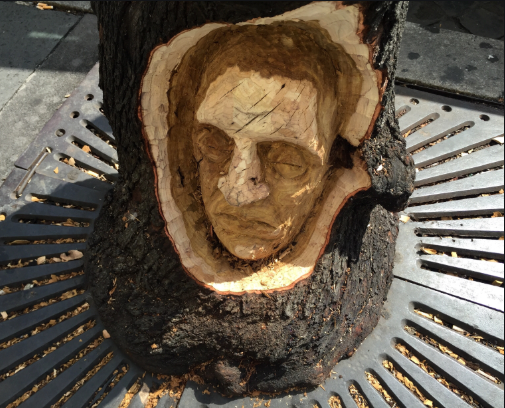
trees, as any other live organism, can die. What a great idea Andrea Gandini had to decorate their trunk and embellish the surrounding area? This Italian artist lives in Rome and this is his beautiful website: http://andreagandini.art/ Here below, some of his beautiful art creations..
Happy 2019!! new year = new inspiration!!Please find here below an article I found in the BBC New which encourage citizens to take actions against governments decisions!!
Enjoy the reading!!
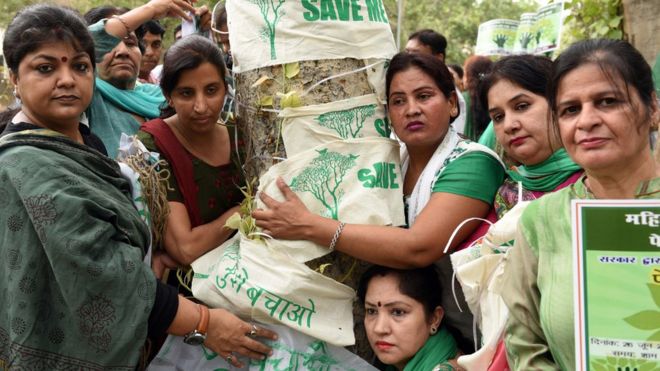
Image copyrightGETTY IMAGESImage captionIn one such protest, Delhi residents hugged trees that were to be cut
"A citizen-led movement in India's capital Delhi has successfully halted the cutting of more than 16,000 trees in the city. The BBC's Nikita Mandhani talked to some people actively involved in this movement.
Juhi Saklani, 48, recounts how horrified she felt when she first heard about a government proposal to cut thousands of trees in the heart of Delhi to build houses for government employees. "Some of us who love trees and feel strongly about the connection of trees with pollution felt that this was a criminally wrong plan," says Ms Saklani, adding that this was what forced her to become a "citizen activist".
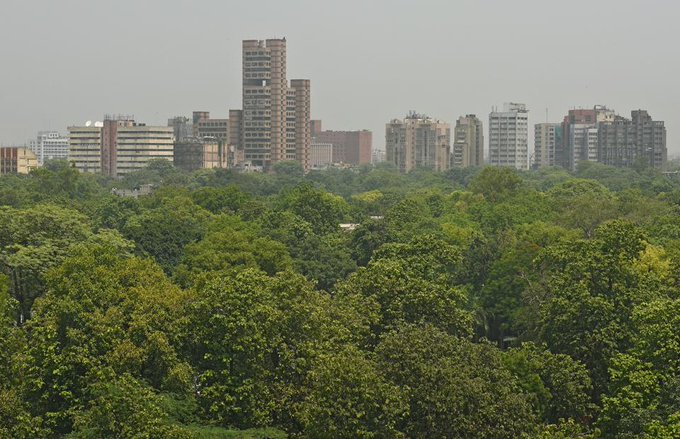
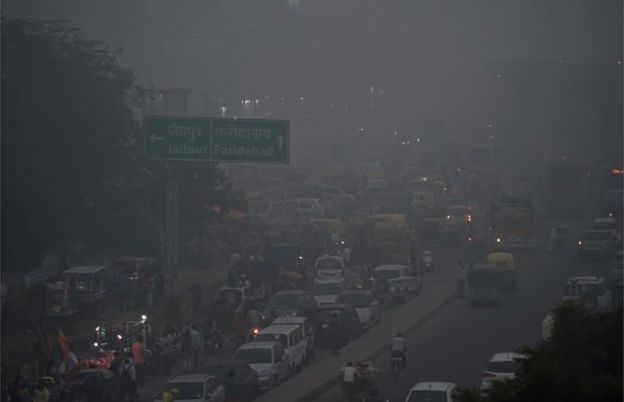
Delhi is one of the world's most polluted cities, with air quality frequently reaching hazardous levels. The one mitigating factor is that large parts of the city still have substantial green cover, although this has also been depleting due to development projects. The latest plan to cut thousands of trees across seven Delhi neighbourhoods had actually been approved in July 2016. But the news only became public in June 2018 after media reports highlighted that about 11,000 trees were due to be felled in a single neighbourhood. Almost overnight, hundreds of residents, including environmental and anti-pollution organizations, formed a collective to fight against it.
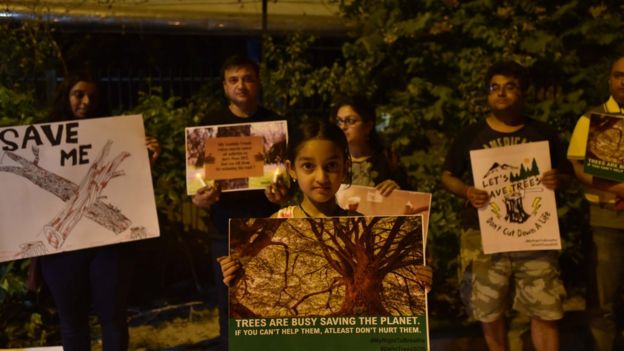
Image copyrightGETTY IMAGESImage captionSeveral Delhi residents participated in candle-light vigils to protest against the cutting of trees
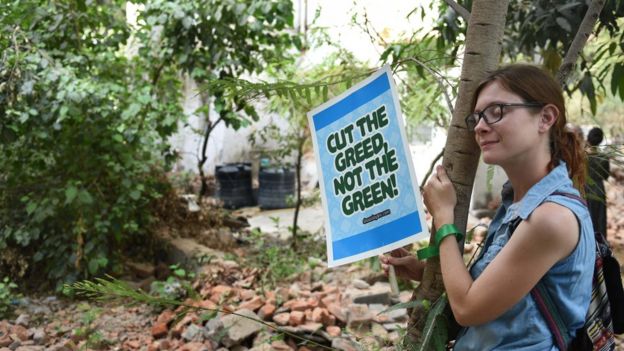
Activists began mobilizing opinion and people. The movement gained traction on social media and messaging apps like WhatsApp, inspiring more than 1,000 people to protest in various ways. These ranged from sit-ins to tree-climbing workshops, candle-light vigils, meditation protests, tree plantation activities and all-day patrolling efforts to keep a watch on the trees. For Delhi-based environmentalist Vimlendu Jha, this movement became a key part of his "green activism".Mr Jha is the founder of Swecchha, a non-profit organization that works on environmental and youth issues, and he has consistently led and participated in activities to make Delhi more "liveable". As someone who has planted thousands of trees across Delhi over the years, he felt that the government's plan violated citizens' right to clean air. "The government is the custodian of citizens' rights and the environment," he said, adding that instead of taking steps to "take us out of this environmental hazard", the government was only making it worse.
Image copyrightGETTY IMAGESImage captionThe trees were proposed to be a cut for a government redevelopment project in Delhi
Verhaen Khanna, an environmentalist who started a social media collective called the New Delhi Nature Society, agreed. "None of the existing trees should be cut as they're living ecosystems within themselves," he said. Over the past few years, Mr Khanna has been trying to cure "tree blindness", a "disease" which he says is prominent in big cities - that people have no idea about the natural beauty around them. He regularly leads workshops and activities related to climbing trees, meditating under them, walking barefoot on grass plains and trekking across Delhi's lesser-known forested areas. "It's a really devastating thing to happen to everybody in this city of almost 20 million people. Losing so many trees is catastrophic," he added.
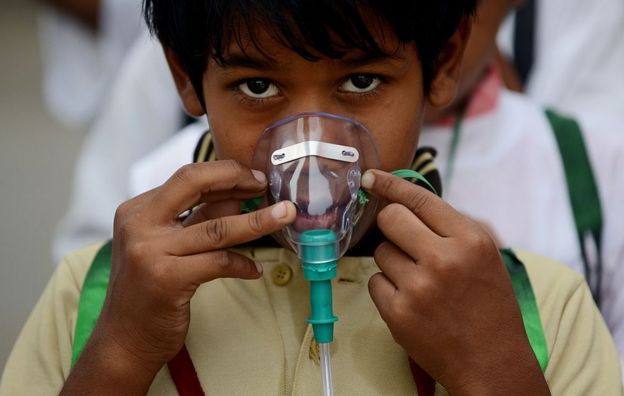
Image copyrightAFPImage captionChildren are among the worst affected by air pollution
Taken by surprise at the vehemence of public reaction, India's federal government retaliated. First they said that "only 14,000 trees were to be cut". They then promised to plant 10 saplings for every tree that is cut under what they called measures for "compensatory afforestation". Ms Saklani called the announcement "an incredible hogwash", pointing out that the survival rate for saplings in India is "dismal". "Also, how does it help if the saplings are planted 30km away from these neighbourhoods?" Mr Khanna also dismissed the government's justification and reparation plans. "They don't realize half a century or a full century is gone in creating those organisms using the country's natural resources," he said. Then on 28 June, the country's housing and urban affairs minister tweeted that "no trees will henceforth be cut in the process of redevelopment of Delhi colonies". ip Twitter post by @HardeepSPuri
"We will revisit our urban design in such a way we don't have to cut the trees," Housing and Urban Affairs Secretary Durga Shanker Mishra told the BBC. "We may lose some build-up area for the sake of environment." But by then, two separate petitions against the government had been filed in the high court and the National Green Tribunal (NGT), an environmental court. Both stayed the government project. Then on 4 July, the high court dealt it a definitive blow, saying no trees could be cut in the entire city of Delhi till further orders. It said it would "not allow Delhi to die at the cost of the redevelopment projects".
Image copyrightAFP
Dr Kaushal Kant Mishra, an orthopaedic surgeon, who filed the successful petition in the high court, is the president and founder of Youth for Equality, a non-profit working towards creating equal opportunities and good governance in the country. He has filed numerous petitions in the court against caste-based discrimination and women's rights, but this is Mr Mishra's first environmental fight. "I had never expected this movement to become so popular," he added, noting that Delhi's high pollution levels had forced many people to join this tussle against the government. Dr Mishra and other activists welcomed the court's decision as a victory for the people of Delhi against the authorities. p Twitter post by @vimlend
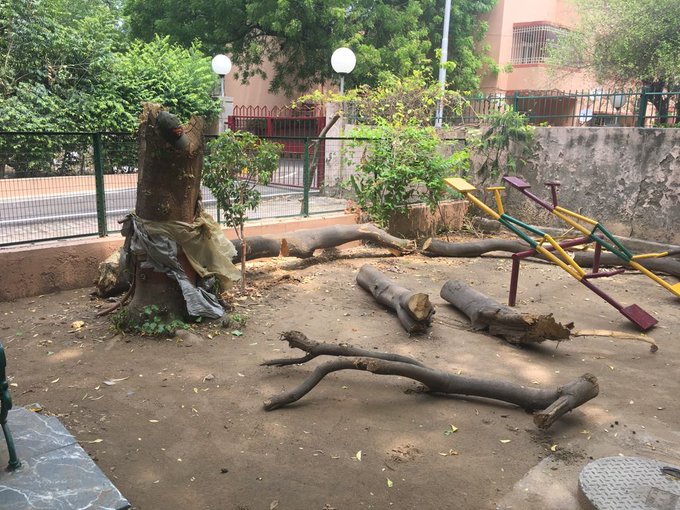
But activists are still worried. They say that despite previous orders, government contractors are still cutting and uprooting trees. In fact Mr Jha had filed a "contempt of court" case after witnessing one such incident himself.
So, they don't want to stop yet. They say Delhi needs more greenery and less pollution and that will be possible only when the city's residents become more aware and active - if not, it will become too easy for authorities to keep cutting trees in the guise of various projects. They are now focused on educating the population, especially children, about the importance of trees and how cutting them would adversely affect the environment."
Baobabs grow in arid regions such as Madagascar, Africa, Arabia and Australia. In the early 21 century African baobabs suffered a disease which killed lots of them and dehydration cause by the global warming just accelerated the process.
Among the many Baobabs that are present in this world there are some which have a very long life, in particular in in South Africa where it is possible to find a 6 thousands years old Baobab which hold a pub inside itself. Its height 22 metres and its circumference reach almost 50 metres: it is considered the biggest ever!!
Today I would like to talk about
travellers and travelling.
Most of the time, travelling is
associate to a possible threat to natural environments and local communities of
a country rather than something beneficial.
G Adventures seems to make
the difference.
This travel company for over 25 years not only helped travellers
to integrate travelling into the different cultures but it also sustained local
communities while doing that. After the firsts successes in 2003,
Mr Bruce Poon Tip founder of G Adventures, established a non-profit
organization called "Planeterra Foundation". The aim of this company
is to invest the donations they collect from travellers into development
projects, in the last 15 years they have been able to support different
businesses from healthcare to conservation.
This is how
they define themselves: “Planeterra helps to
start something. Once a social enterprise is up and running the impacts begin
to multiply within the community. We believe that tourism can be the greatest
method of wealth distribution in the world, and we’re out to prove it.” <https://planeterra.org/about-us/>
In Nairobi
in Kenya, for instance, G Adventures Safari Central cooperated with Café’
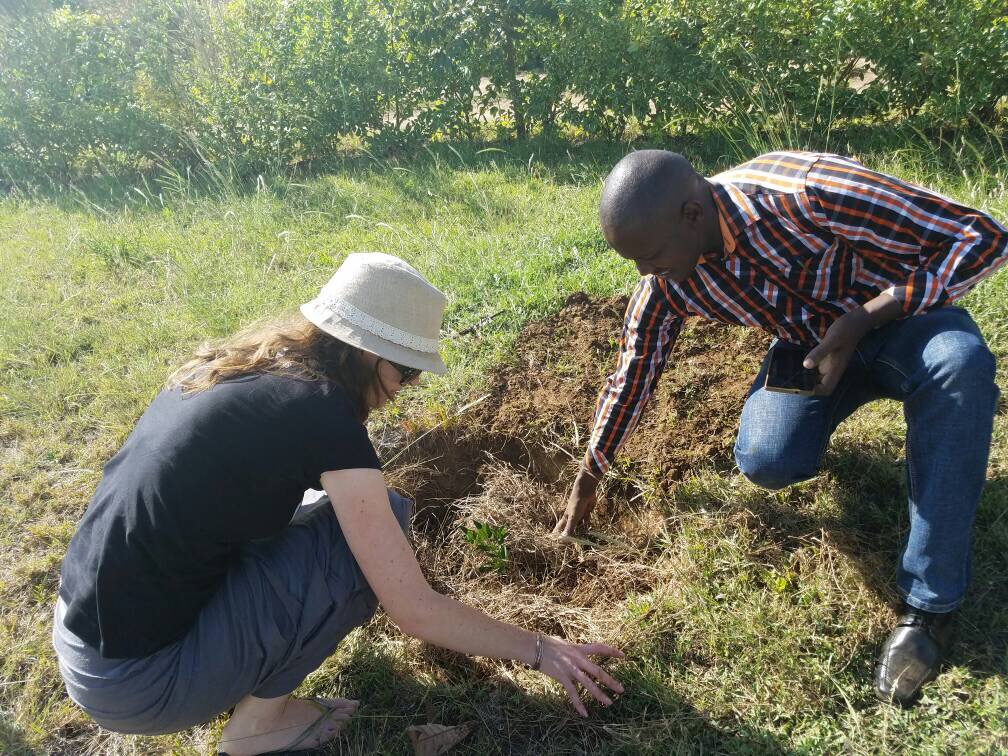
Ubuntu. Together they planted trees during the Earth Weeks and now this café’
supports Special needs' schools and local women whose children are living with
disabilities.
Among the various projects
Planeterra is developing there is also one in Guneysinir,
in Turkey. This area is particularly dry
and between July and September, and the average rainfall is less than 10mm.
Accordingly with recent researches on the territory, it resulted that the
population is growing and the limited agriculture resources of the natural
environment are unable to feed the population.
Considering characteristics of
this land, it has been found out that almond orchards are the best trees to
plants in order to optimize the water retention. When travelling with G Adventures in Guneysinir, there will be the
chance to plant some trees in the orchard. Tourists will have the opportunity
to visit the park, interact with the local residents and learn further about
the project. This almond plantation provides sheds for people, improves water retention in the soil and the selling of almonds is a source of income.
“This
project was inspired by conversations with G Advenutres' field staff and the
residents participating in the home stay experience. The goal is to provide an
opportunity for travellers to spend time in a community park and contribute to
a budding social enterprise. With the help of the local municipality, we
identified a 10,000 sq.m. plot of land that is perfectly suited for this type
of multi-year development project.” <https://planeterra.org/what-we-do/our-projects/turkey-almond-cooperative/>
I got to know G Adventures during my University time when I
attended a convention held by mr Poon Tip here in London. I found very inspiring this
new way of looking at tourism as a resource rather than as something harmful.
I firmly believe there should be more initiatives like this, the
world is one and it is an unique place: we need to take good care of it.