Showing posts with label save the planet. Show all posts

Wednesday, 26 June 2019

PLASTIC STRAWS, STIRRERS AND COTTON BUDS TO BE BANNED from Metro


Hi again,

here below another dramatic article that describes the plastic pollution of our planet. I really believe that more needs to be done specially in terms of education and recycling.

Enjoy the reading and text me you thoughts.


"PLASTIC straws, drink stirrers and cotton buds are to be banned in England from next year to tackle pollution.
Environment secretary Michael Gove confirmed the supply of the items will stop from April 2020 after ‘overwhelming’ public support for the measure.
Exemptions will allow those who need plastic straws for an illness or disability to buy them from pharmacies or request them in restaurants and pubs, and will let cotton buds be used for medical and scientific purposes.
More than 80 per cent of respondents in a public consultation backed a ban on plastic straws, 90 per cent wanted stirrers banned and 89 per cent supported getting rid of plastic cotton buds.
Mr Gove said: ‘Urgent and decisive action is needed to tackle plastic pollution and protect our environment.
‘Today I am taking action to turn the tide on plastic pollution, and ensure we leave our environment in a better state for future generations.’
It is estimated that 4.7billion plastic straws, 316million plastic stirrers and 1.8billion plastic-stemmed cotton buds are used each year in England. There are an estimated 150million tons of plastic in the world’s oceans, and each year 1million birds and more than 100,000 sea mammals die from eating and getting tangled in the waste"

Friday, 4 January 2019

HOW THE PEOPLE FROM DELHI SAVED 16,000 TREES FROM THE AXE

Happy 2019!!

new year = new inspiration!! Please find here below an article I found in the BBC New which encourage citizens to take actions against governments decisions!!

Enjoy the reading!! 


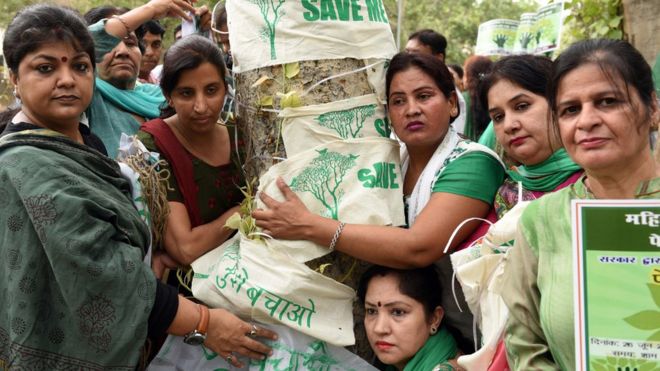
Delhi residents hug a treeImage copyrightGETTY IMAGES
Image captionIn one such protest, Delhi residents hugged trees that were to be cut

"A citizen-led movement in India's capital Delhi has successfully halted the cutting of more than 16,000 trees in the city. The BBC's Nikita Mandhani talked to some people actively involved in this movement.
Juhi Saklani, 48, recounts how horrified she felt when she first heard about a government proposal to cut thousands of trees in the heart of Delhi to build houses for government employees. "Some of us who love trees and feel strongly about the connection of trees with pollution felt that this was a criminally wrong plan," says Ms Saklani, adding that this was what forced her to become a "citizen activist".
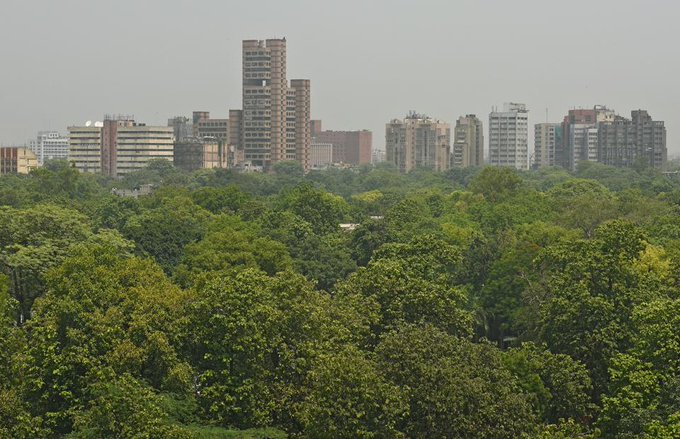
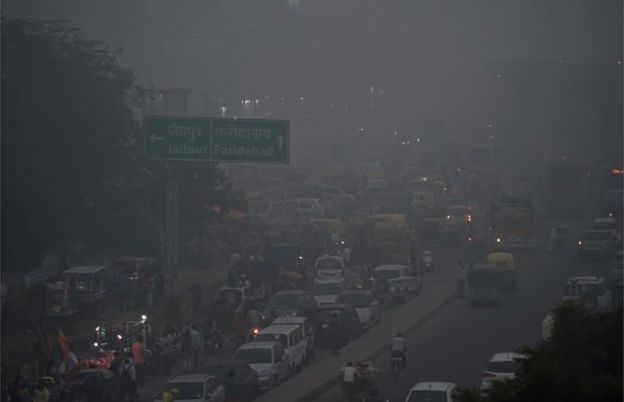
Delhi is one of the world's most polluted cities, with air quality frequently reaching hazardous levels. The one mitigating factor is that large parts of the city still have substantial green cover, although this has also been depleting due to development projects. The latest plan to cut thousands of trees across seven Delhi neighbourhoods had actually been approved in July 2016. But the news only became public in June 2018 after media reports highlighted that about 11,000 trees were due to be felled in a single neighbourhood. Almost overnight, hundreds of residents, including environmental and anti-pollution organizations, formed a collective to fight against it. 

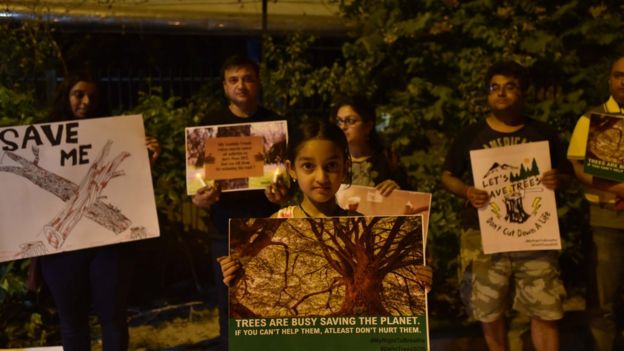
Residents hold placards and light candles to protest against the cutting of more than 16,000 treesImage copyrightGETTY IMAGES
Image captionSeveral Delhi residents participated in candle-light vigils to protest against the cutting of trees

Activists began mobilizing opinion and people. The movement gained traction on social media and messaging apps like WhatsApp, inspiring more than 1,000 people to protest in various ways. These ranged from sit-ins to tree-climbing workshops, candle-light vigils, meditation protests, tree plantation activities and all-day patrolling efforts to keep a watch on the trees. For Delhi-based environmentalist Vimlendu Jha, this movement became a key part of his "green activism".Mr Jha is the founder of Swecchha, a non-profit organization that works on environmental and youth issues, and he has consistently led and participated in activities to make Delhi more "liveable". As someone who has planted thousands of trees across Delhi over the years, he felt that the government's plan violated citizens' right to clean air. "The government is the custodian of citizens' rights and the environment," he said, adding that instead of taking steps to "take us out of this environmental hazard", the government was only making it worse.
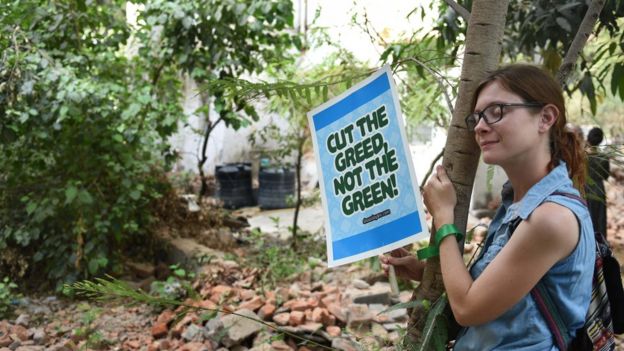
A woman hugs a tree as she holds a placard reading, 'Cut the Greed, Not the Green'

Image copyrightGETTY IMAGES
Image captionThe trees were proposed to be a cut for a government redevelopment project in Delhi

Verhaen Khanna, an environmentalist who started a social media collective called the New Delhi Nature Society, agreed. "None of the existing trees should be cut as they're living ecosystems within themselves," he said. Over the past few years, Mr Khanna has been trying to cure "tree blindness", a "disease" which he says is prominent in big cities - that people have no idea about the natural beauty around them. He regularly leads workshops and activities related to climbing trees, meditating under them, walking barefoot on grass plains and trekking across Delhi's lesser-known forested areas. "It's a really devastating thing to happen to everybody in this city of almost 20 million people. Losing so many trees is catastrophic," he added. 

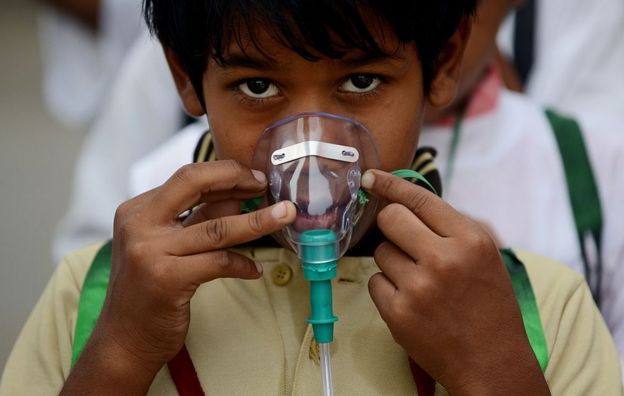
An Indian schoolchild adjusts his facemask before the start of an event to spread awareness of the problem of air pollution in New Delhi on June 4, 2015, on the eve of World Environment Day.Image copyrightAFP
Image captionChildren are among the worst affected by air pollution

Taken by surprise at the vehemence of public reaction, India's federal government retaliated. First they said that "only 14,000 trees were to be cut". They then promised to plant 10 saplings for every tree that is cut under what they called measures for "compensatory afforestation". Ms Saklani called the announcement "an incredible hogwash", pointing out that the survival rate for saplings in India is "dismal". "Also, how does it help if the saplings are planted 30km away from these neighbourhoods?" Mr Khanna also dismissed the government's justification and reparation plans. "They don't realize half a century or a full century is gone in creating those organisms using the country's natural resources," he said. Then on 28 June, the country's housing and urban affairs minister tweeted that "no trees will henceforth be cut in the process of redevelopment of Delhi colonies". ip Twitter post by @HardeepSPuri
"We will revisit our urban design in such a way we don't have to cut the trees," Housing and Urban Affairs Secretary Durga Shanker Mishra told the BBC. "We may lose some build-up area for the sake of environment." But by then, two separate petitions against the government had been filed in the high court and the National Green Tribunal (NGT), an environmental court. Both stayed the government project. Then on 4 July, the high court dealt it a definitive blow, saying no trees could be cut in the entire city of Delhi till further orders. It said it would "not allow Delhi to die at the cost of the redevelopment projects". 

Traffic is seen through heavy smog in New Delhi on November 8, 2017.Image copyrightAFP

Dr Kaushal Kant Mishra, an orthopaedic surgeon, who filed the successful petition in the high court, is the president and founder of Youth for Equality, a non-profit working towards creating equal opportunities and good governance in the country. He has filed numerous petitions in the court against caste-based discrimination and women's rights, but this is Mr Mishra's first environmental fight. "I had never expected this movement to become so popular," he added, noting that Delhi's high pollution levels had forced many people to join this tussle against the government. Dr Mishra and other activists welcomed the court's decision as a victory for the people of Delhi against the authorities. p Twitter post by @vimlend
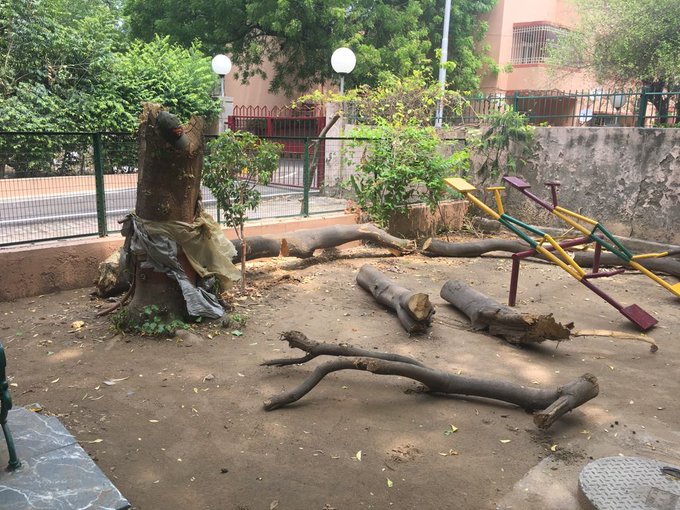
But activists are still worried. They say that despite previous orders, government contractors are still cutting and uprooting trees. In fact Mr Jha had filed a "contempt of court" case after witnessing one such incident himself.
So, they don't want to stop yet. They say Delhi needs more greenery and less pollution and that will be possible only when the city's residents become more aware and active - if not, it will become too easy for authorities to keep cutting trees in the guise of various projects. They are now focused on educating the population, especially children, about the importance of trees and how cutting them would adversely affect the environment."


Full article can be found:
https://www.bbc.co.uk/news/world-asia-india-44678680

Sunday, 23 September 2018

OZONE HOLE & CHINA INSULATION: WHAT'S THE LINK?


I will report here below an article that I recently found in the BBC World News which questions the possible links between the home insulation used in China and the diminish of the ozone layer.

Very interesting reading!!


"Cut-price Chinese home insulation is being blamed for a massive rise in emissions of a gas, highly damaging to the Earth's protective ozone layer.
The Environmental Investigations Agency (EIA) found widespread use of CFC-11 in China, even though the chemical was fully banned back in 2010. Scientists have been extremely puzzled by the mysterious rise in emissions. But this report suggests the key source is China's home construction industry. Just two months ago, researchers published a study showing that the expected decline in the use of CFC-11 after it was completely banned eight years ago had slowed to a crawl. There were suspicions among researchers that new supplies were being made somewhere in East Asia. Rumours were rife as to the source. There was a concern among some experts that the chemical was being used to secretly enrich uranium for use in nuclear weapons.
The reality it seems is more about insulation than proliferation. 

* Electric car points in all new homes planned 
*Exoskelotons promise superhuman powers
* Can we save the Lord of the Ring toad?

So why is this important? What can be done about this? What is the ozone layer and why is it important? Remind me how the hole in ozone layer came about? So what did the world do about this? I thought the ozone hole was recovering?
CFC-11 makes a very efficient "blowing agent" for polyurethane foam, helping it to expand into rigid thermal insulation that's used in houses to cut energy bills and reduce carbon emissions. Researchers from the EIA, a green campaign group, contacted foam manufacturing factories in 10 different provinces across China. From their detailed discussions with executives in 18 companies, the investigators concluded that the chemical is used in the majority of the polyurethane insulation the firms produce. One seller of CFC-11 estimated that 70% of China's domestic sales used the illegal gas. The reason is quite simple - CFC-11 is better quality and much cheaper than the alternatives. The authorities have banned CFC-11 but enforcement of the regulation is poor."We were absolutely gobsmacked to find that companies very openly confirmed using CFC-11 while acknowledging it was illegal," Avipsa Mahapatra from EIA told BBC News. "The fact that they were so blasé about it, the fact that they told us very openly how pervasive it is in the market, these were shocking findings for us." The EIA says that its estimates of the amount of the gas being used in China are in the middle of the emissions range calculated by scientists in their report in May. The scientist who first highlighted the problem with CFC-11 said the EIA findings seemed plausible, although it was difficult to be definitive.
Dr Stephen Montzka from the US National Oceanic and Atmospheric Administration (Noaa) told BBC News: "The pervasiveness of the use of CFC-11 that seems apparent in China based on their survey is quite amazing, although it is hard for me to assess the accuracy of the emission estimate they make to know if it is indeed likely that this activity can explain all or most of what we are observing in the global atmosphere."
This is a big deal because of the amount of the dodgy chemical being used and its potential to reverse the healing that's starting to take place in the ozone layer. China's polyurethane foam makes up about one-third of global production, so if they are predominantly using an ozone-depleting substance it will set back the closing of the ozone hole by a decade or more. As well as the ozone layer, CFC-11 has a warming impact. Researchers estimate that if the use of the chemical continues, it would be the equivalent of CO₂ from 16 coal-fired power stations every year! As China is a signatory of the Montreal Protocol that governs the use of ozone-depleting substances, it should be possible to put trade sanctions in place. However, since the protocol was signed in 1987, this weapon of last resort has never been used and it's not expected in this case.
What's more likely is that China will be encouraged to crack down on the production of CFC-11s and to launch a full-scale investigation with the support of the Montreal Protocol secretariat. "It is critical for the government of China not to treat these as isolated incidents," said Avipsa Mahapatra from the EIA. "We want them to clamp down but it's supremely important for them to carry out a comprehensive investigation into the sector. It has to result in seizures, it has to result in arrests so that people know there are harsh penalties for the production of CFC-11." Delegates to the Montreal Protocol are meeting this week in Vienna and they will try to come up with a plan to tackle the issue. 
Ozone is formed in the stratosphere some 15 to 30 km above the surface of the Earth by the interaction of solar ultraviolet radiation with oxygen in the air. In this location, the newly formed ozone absorbs ultraviolet radiation, preventing most of it from reaching the ground. This is important because ultraviolet radiation can lead to skin cancer and eye damage in humans, can damage crops and marine life. Scientists discovered in 1985, much to their surprise, that there was a 30% drop in ozone levels over Antarctica in October of that year. By 1992, the hole was as large as North America. 
What was happening was that chemicals called chlorofluorocarbons contained in refrigeration, air conditioning, packaging, insulation, solvents, and aerosol propellants were releasing chlorine or bromine molecules when they were exposed to intense UV light in the stratosphere. When chlorine and bromine atoms come into contact with ozone, they destroy the molecules. One chlorine atom can destroy over 100,000 ozone molecules before it is removed from the stratosphere. Ozone can be destroyed more quickly than it is naturally created. For once, the world acted speedily and to good effect. Most nations, including the chemical industry, signed up to the Montreal Protocol which quickly banned most of the worst-offending chemicals. Developing countries were given much longer to replace the gases. So while most of the richer countries got rid of CFC-11 in the mid-1990s, China and others were expected to completely get rid of it in 2010. That obviously hasn't happened just yet. Back in 2014 researchers reported the first signs of a thickening in the ozone layer. At that point they said it would take a decade for the hole to start to shrink but by September 2015 scientists found that the hole was approximately 4 million sq km smaller than it was in the year 2000 - that's an area the size of India.
All this was due to the global phase out of CFCs. So it was a major surprise to ozone experts to find that the expected decline in these elements in the air had stalled. And now, according to the EIA, the reason behind the slowdown has been discovered - and it's mainly down to Chinese builders!"

Full article can be found at:
https://www.bbc.co.uk/news/science-environment-44738952

Thursday, 6 September 2018

KENYAN INNOVATION TAKES PLASTIC BAGS OUT OF FORESTRY


Hello All,

please find here below an article I recently found in a BBC link which was talking about plastic pollution and reforestation.
Kenya already banned the use of plastic bags in 2017, what are we waiting for?

Great highlights and new points of view form Kenya, enjoy the reading!!


"KENYAN INNOVATION TAKES PLASTIC BAGS OUT OF FORESTRY

Plastic bags are known for their environmental impact. They slowly release toxic chemicals once in the soil, for instance, and find their way into the guts of animals that often choke and die as a result.

Kenya banned the use of plastic bags in 2017. And thanks to a 43-year old Kenyan, Teddy Kinyanjui, an innovative afforestation and reforestation method for developing seedlings without using plastic bags is in place.


A resident of Nairobi and founder of Cookswell Jikos Limited, Kinyanjui has invented small, portable seed balls to grow and easily disperse seedlings. He is working in partnership with Kenya Forestry Research Institute (KEFRI), which certifies seeds.This photo gallery shows Kinyanjui’s ingenuity in using the seed balls instead of the usual plastic bags.

When tree seedlings are grown in plastic bags in a nursery, he explains, the roots get squeezed and this limits their ability to grow fast. The seed ball method enables roots to adapt easily, with less disturbance.
Kinyanjui says he has engineered a method of coating each seed with charcoal dust, and corn or cassava starch, to bind each ball so the seeds are protected from prey, pests and diseases.


He says he has the capacity to make one tonne of the seed balls per day. So far, since the project’s initiation in 2016, about one million seeds of different species of certified indigenous trees have been dispersed throughout Kenya through partnerships with locals and with a germination rate of 60 per cent.
“People use charcoal every day, necessitating for more trees. Climate change has also caused community conflicts, especially among pastoralists in Northern Kenya who fight over pasture for their animals,” says Kinyajui. “Good environmental management is, therefore, crucial for peace among these communities.”

He hopes to partner with like-minded organisations and youth who herd livestock with slings to disperse more seeds in arid lands.

“We would [also] like people to see the value of this simple technology
 as a contributing factor in combating and adapting to effects of climate change, as this is the cheapest way to encourage tree planting, especially in arid and semi-arid areas,” adds Kinyanjui."


Full article can be found:
https://www.scidev.net/global/environment/multimedia/kenyan-innovation-takes-plastic-bags-out-of-forestry.html

Tuesday, 21 August 2018

HOW TO GREEN THE WORLD'S DESERTS AND REVERSE CLIMATE CHANGE | Allan Savory


https://www.youtube.com/watch?v=vpTHi7O66pI


This video is from a TED talk of the 2013 and it perfectly explains how we can fight the deserts expansion in our beloved planet Earth. 

Absolutely great!! 💗

Have a look and tell me what you think!!


Thank you Allan Savory!!